Updated September 2026 · By the AlohaClothes team, a family-owned shop on Maui since 1998
Short answer
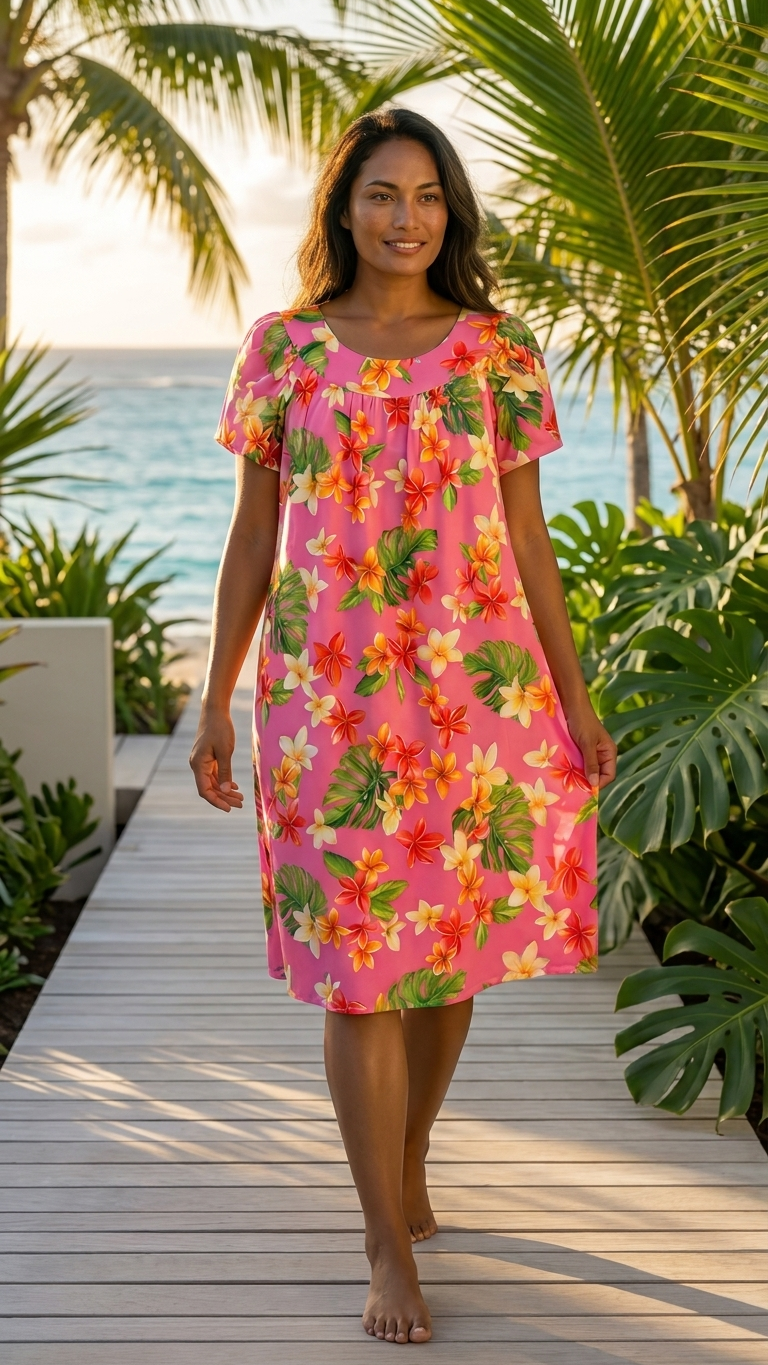
A muumuu (Hawaiian: muʻumuʻu) is a loose, flowing Hawaiian dress that hangs from the shoulders without a fitted waist. The word means "cut off" or "shortened." It started in the 1800s as the simple shift worn under the holokū, a fitted gown with a train, and became everyday wear in its own right.
People search for it every way you can spell it: muumuu, muu muu, mumu, moo moo. They're all the same dress. The Hawaiian spelling uses two ʻokina (the glottal stop mark), muʻumuʻu, and that's what you'll see on signs and in local newspapers here.
What does the word muumuu mean?
Muʻumuʻu translates to "cut off" or "shortened." The name describes what it is: a holokū with pieces taken away. No yoke, no train, shorter sleeves. What's left is a dress you can actually move in, which is exactly why it outlived its fancier parent as the thing people wear on a regular Tuesday.
Where did the muumuu come from?
The story starts in April 1820, when the first American missionaries arrived in Hawaiʻi. A high chiefess named Kalākua Kaheiheimālie had the missionary wives sew her a Western-style gown from her own white cambric, and the first sewing circle in the islands formed around that project, with Kalākua directing it. Historians at Kaʻahele Hawaiʻi make a point we like: Hawaiian women chose this style. It spread because people wanted it, not because anyone forced it on them.
That gown became the holokū. Underneath it, women wore a loose shift with short sleeves and no train. That undergarment was the muʻumuʻu. By around 1840 the style had spread well beyond the aliʻi (the chiefly class), and over the following century the muumuu moved from underneath to on top.
Today it's formally celebrated, too. January was named Muʻumuʻu Month for the first time in 2015 after a social media campaign, and it's been proclaimed again since, according to KHON2.

What's the difference between a muumuu and a holoku?
| Muumuu | Holokū | |
|---|---|---|
| Fit | Loose, hangs from the shoulders | Fitted bodice with a yoke |
| Length | Knee to ankle | Floor length with a train |
| Origin | The shift worn underneath | The gown sewn for Kalākua in 1820 |
| Worn today for | Everyday, luau, weddings, Aloha Friday | Formal occasions and ceremonies |
How do you wear a muumuu today?
However you want, honestly. It's the most forgiving dress in Hawaii. Here's how it usually goes:
- Everyday: loose and unbelted with slippers (that's flip-flops, if you're not from here).
- Luau or party: a bolder print, a flower behind the ear, dressy sandals.
- Hawaiian wedding guest: a longer length in a softer print, or a matching print with your partner's aloha shirt.
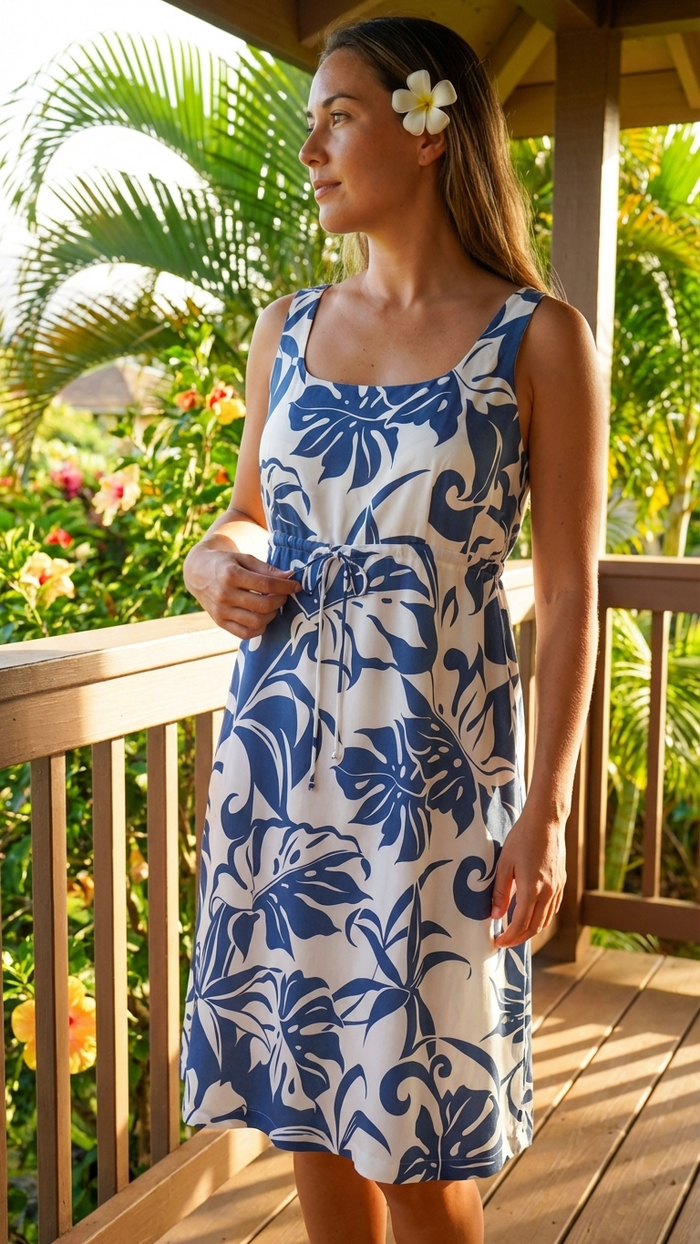
- Work on Aloha Friday: a knee or midi length with a light cardigan for the air conditioning.
Our guide to aloha attire goes deeper on dress codes if you've got an invitation in hand.

100% cotton · made in Hawaii
RJC Rainbow Plumeria MuumuuClassic loose cut in four colors. Sizes S to XL, plus 1X to 3X.
From $68.99See the dressIs my muumuu actually made in Hawaii?
This is the question we get most at our Maui shop, right alongside "will it shrink?" It's a fair one. Plenty of dresses sold as "Hawaiian" are printed and sewn somewhere else entirely.
Check two things. First, the label: a real one says Made in Hawaii, or Made in Hawaii, USA. Second, the fabric. Most Hawaii-made muumuus are 100% cotton or 100% rayon, not polyester. Every muumuu and evening dress in our collection is made in Hawaii by RJC, a Hawaii aloha wear maker since 1953, and each product page says so in its first line. If a listing anywhere won't tell you where a dress was made, that tells you something.
How should a muumuu fit?
Loose. That's the point. Our RJC muumuus have a relaxed, flowing cut, so most people stay with their usual size for comfort and size down only if they want it closer to the body. Plus sizes run 1X to 3X.
For washing, cotton muumuus go on a gentle cold cycle and line dry best. Our care guide covers rayon, which needs a gentler hand.

100% cotton · made in Hawaii
Pineapple Hibiscus Muu Muu DressPineapples and hibiscus in an easy, loose cut.
From $68.99See the dressFrequently asked questions
Is it muumuu, mumu or moo moo?
All three refer to the same dress. The correct Hawaiian spelling is muʻumuʻu, pronounced roughly "moo-oo-moo-oo." "Muumuu" is the standard English spelling, and "mumu" or "moo moo" are phonetic versions you'll see online.
What is a Hawaiian dress called?
The two traditional Hawaiian dresses are the muumuu, a loose everyday dress, and the holokū, a fitted formal gown with a train. Modern Hawaiian dresses also include sarong or wrap styles and sundresses in aloha prints.
What is an empire waist dress?
An empire waist has its seam just under the bust instead of at the natural waist, so the skirt falls loose from there. Some modern Hawaiian dresses use it. A classic muumuu usually has no waist seam at all.
Can non-Hawaiians wear a muumuu?
Yes. It's worn all over the islands by people of every background, and wearing one to a luau or wedding is welcome. Buying one made in Hawaii supports the local makers who keep the tradition going.
Where can I buy a muumuu made in Hawaii?
Look for a Made in Hawaii label and natural fabric. Everything in our muumuu collection is made in Hawaii by RJC, the classic muumuus in 100% cotton, and it ships from our store on Maui.
Find your muumuu
Made in Hawaii, in sizes S to 3X, shipped from Maui.
Shop muumuusFamily-owned on Maui since 1998 · Rated 4.7 out of 5 across 6,330 Amazon reviews · Free US shipping with code FREE · Returns within 30 days